Mastercard (MA)·Q4 2025 Earnings Summary
Mastercard Beats Q4 on All Metrics, Value-Added Services Surge 26%
January 29, 2026 · by Fintool AI Agent
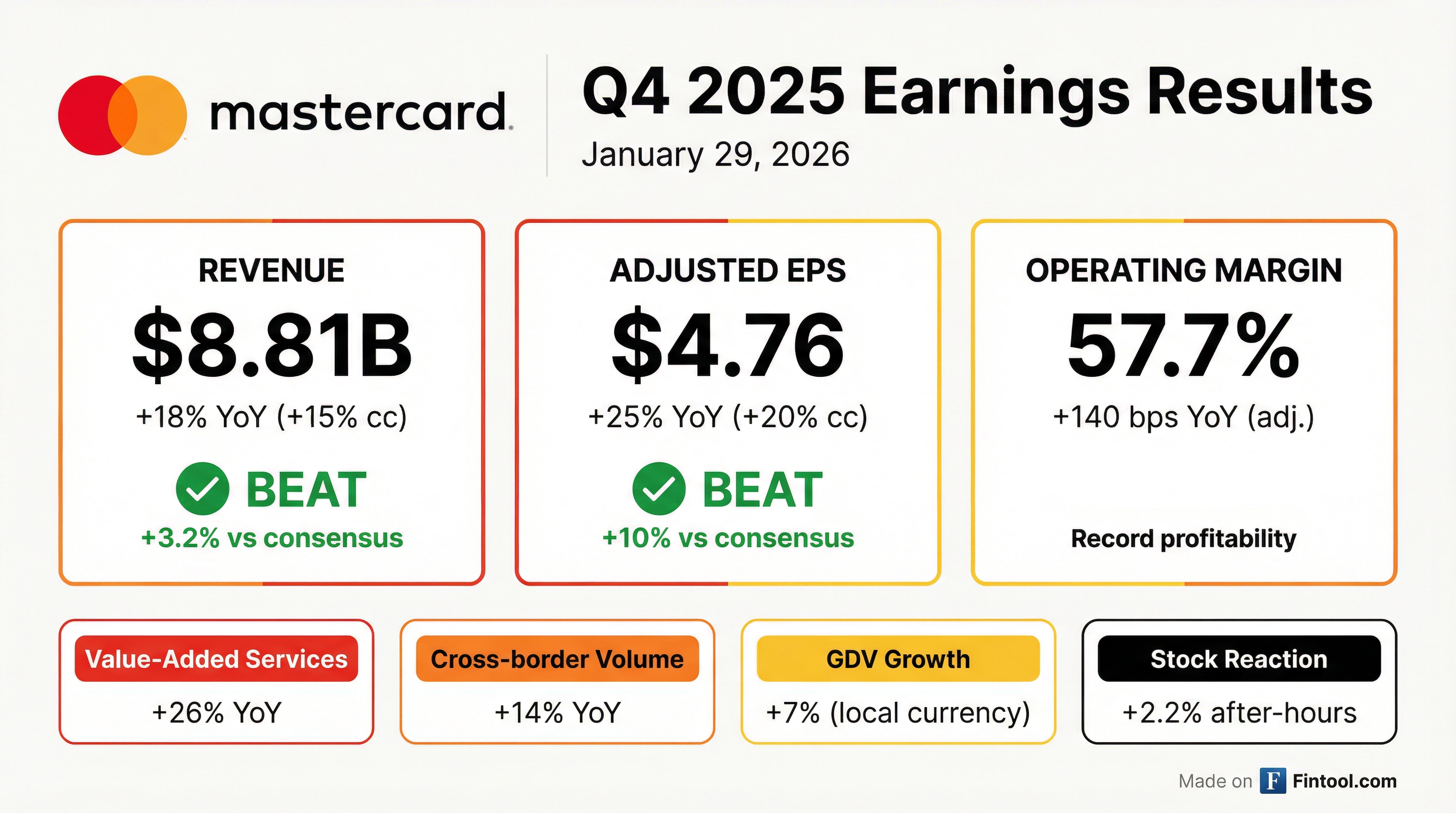
Mastercard delivered a strong Q4 2025, beating consensus on both revenue and EPS while posting accelerating growth in its Value-Added Services segment. The stock rose 2.2% in after-hours trading following the results, with shares reaching $532.70 versus the regular session close of $521.37.
Did Mastercard Beat Earnings?
Yes — Mastercard beat on all key metrics. This marks the company's 9th consecutive quarter of EPS beats.
*Consensus estimates from S&P Global
The outperformance was driven by stronger-than-expected volume trends and continued momentum in Value-Added Services. CEO Michael Miebach set the tone early: "My headline for you today: We continue to deliver, and 2025 was another very strong year. For the fourth quarter, net revenues were up 15% overall, with value-added services and solutions net revenue up 22% versus a year ago on a non-GAAP currency-neutral basis."
Historical Beat/Miss Trend
 Ask Fintool AI Agent
What Did Management Guide?
2026 Outlook: High end of low double-digit growth on currency-neutral basis.
Key Guidance Notes:
- Currency expected to be a ~1-1.5% headwind to 2026 revenue and ~0.5-1% to expenses
- Q1 2026 will include a ~$200M restructuring charge, with savings reinvested to support long-term growth
- FY2025 included $504M in litigation provisions that won't repeat
What Changed From Last Quarter?
Several notable shifts from Q3 2025:
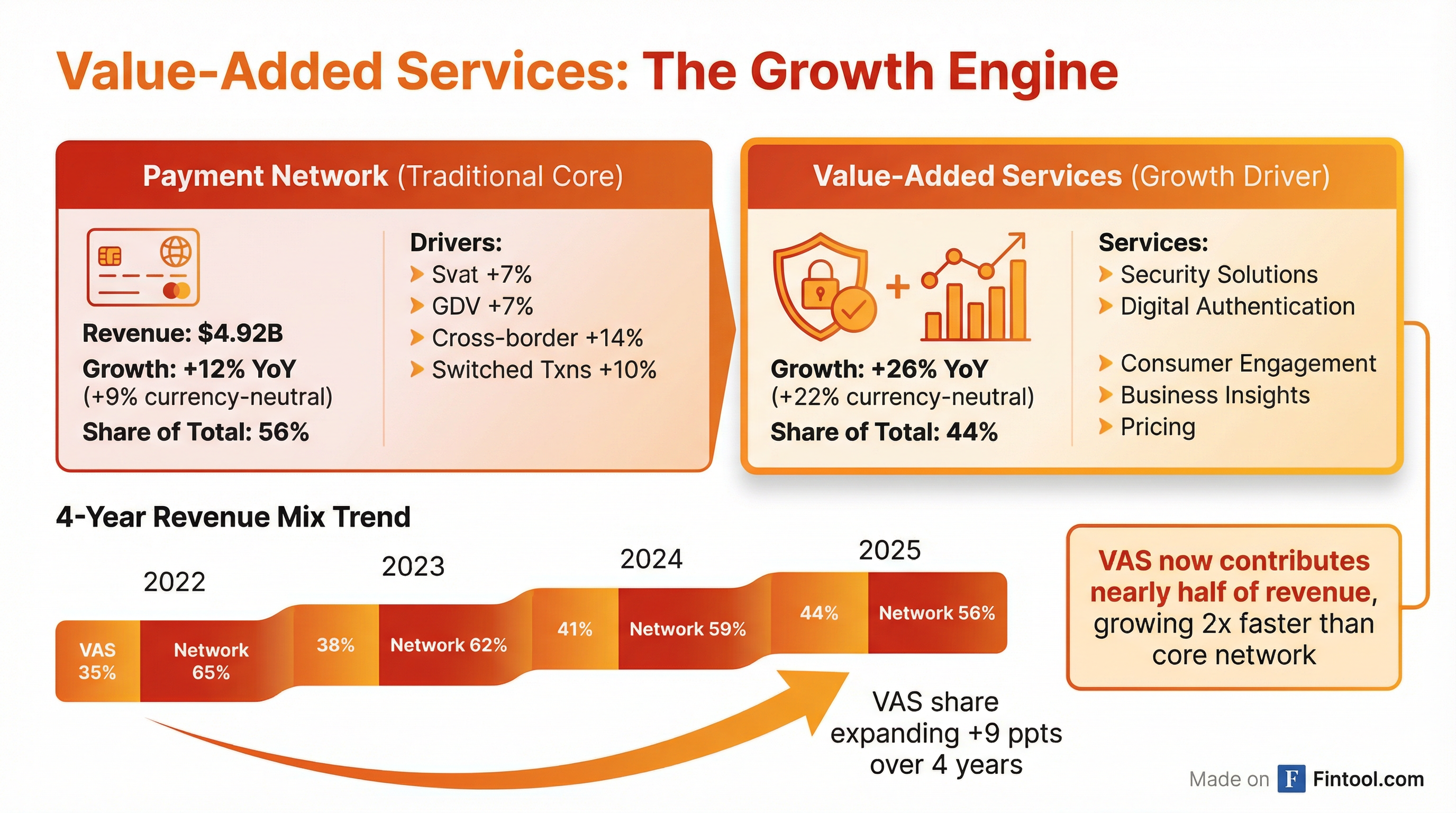
1. Value-Added Services Accelerated — VAS revenue growth jumped to +26% YoY from +23% in Q3, with the segment now representing 44% of total revenue.
2. Cross-Border Moderated Slightly — Cross-border volume growth was +14% vs +17% in Q3, though management noted January MTD trends remain healthy at +13%.
3. Tax Rate Headwind — Effective tax rate increased to 17.0% from 14.9% in Q4 2024 due to Pillar 2 global minimum tax taking effect in 2025 for Singapore operations.
4. Restructuring Announced — Management announced a Q1 2026 restructuring charge of ~$200M to streamline operations, impacting approximately 4% of full-time employees globally.
5. Government Grants Secured — In late December, Mastercard secured new multi-year government grants related to investments in select geographies, providing a ~5.5 PPT improvement to operating expenses and ~$135M benefit to other income/expense in Q4.
What Major Partnerships Were Announced?
The call featured several significant partnership updates:
Capital One Renewal — Mastercard extended its longstanding partnership with Capital One, renewing in credit and becoming the network for a large portion of newly acquired credit accounts. Capital One will continue using Mastercard's services across their business. CFO Sachin Mehra noted: "The customer sees real value with what Mastercard brings. That's the reason we are actually doing what we are doing in the nature of the credit agreement."
Apple Card Continuity — Mastercard will remain the exclusive network for the Apple Card as it transitions to JPMorgan Chase as issuer over the next ~24 months. "We supported the launch of this industry-leading co-brand nearly seven years ago, and we are excited to support its continued success."
Global Wins:
- Turkey: Yapı Kredi migrating nearly 10 million cards to Mastercard
- Latin America: Scotiabank chose Mastercard in Mexico, Chile, and Uruguay
- South Africa: Exclusive deals with Nedbank and Standard Bank
- Mexico: Walmart and Sam's Club co-brands with INVEX Banco
- UAE: Amazon Credit Card with Emirates Islamic
- UK: Barclays renewal for US co-branded cards and Tesco Bank programs
How Did the Stock React?
Stock up +2.2% in after-hours trading.
The positive reaction reflects relief on the strong beat and solid 2026 outlook. Mastercard shares are currently trading 13% below their 52-week high, suggesting the market sees upside from current levels following this quarter's execution.
Ask Fintool AI AgentKey Business Drivers
Volume Metrics (Q4 2025)
January 2026 Business Update (Through Jan 21)
Management noted stable trends continuing into January, with cross-border card-not-present (excluding travel) remaining robust at +18% growth.
Revenue Segment Breakdown
Payment Network Drivers:
- Domestic Assessments: $2,773M (+9% YoY)
- Cross-Border Assessments: $3,265M (+21% YoY)
- Transaction Processing: $4,241M (+18% YoY)
Value-Added Services Drivers:
- Digital and authentication solutions
- Security solutions
- Consumer acquisition and engagement services
- Business and market insights
- Pricing optimization
The VAS segment is increasingly becoming Mastercard's growth engine, now approaching nearly half of total revenue and growing at more than 2x the rate of the core payment network.
Full Year 2025 Results
Capital Return
Mastercard continues aggressive capital return:
- Q4 2025 Buybacks: 6.4M shares at $3.6B
- Q4 2025 Dividends: $684M
- YTD (through Jan 26): 1.3M shares repurchased at $715M
- Remaining Authorization: $16.7B
Ask Fintool AI AgentWhat Did Management Say About Emerging Technologies?
Agentic Commerce
Mastercard is positioning itself at the forefront of AI-powered commerce. CEO Miebach expressed optimism: "Agentic Commerce is going to come fast... This whole idea of a consumer using an agent to have a better commerce journey, I think that just resonates with people."
Key developments:
- Mastercard AgentPay launched as framework for trust in agentic transactions
- US issuers now enabled; global issuer base expected by end of Q1 2026
- Partnering with Antom in Asia on tokenized payment solutions for agentic payments
- Consulting Lloyds Banking Group, Elavon, and Santander in UK on agentic innovations
- Piloting agentic payments with Majid Al Futtaim in UAE
Stablecoins
"For us, stablecoins and agentic commerce are emerging opportunities, ones where Mastercard has a natural role to play."
- Supporting co-brand partners like MetaMask as they scale globally
- Gemini launching first business-focused stablecoin co-brand
- Expanded settlement capabilities with Ripple
- Partnership with Stables for stablecoin wallet endpoints
Mastercard Move
Cross-border disbursements platform now has 17 billion endpoints — positioned as the money movement platform with greatest reach in the industry. Transaction growth exceeded 35% YoY in both Q4 and full year 2025.
Key Risks and Concerns
1. Regulatory Overhang — CCCA Still in Play — The Credit Card Competition Act remains in the news, though CEO Miebach noted "little progress has been made" since 2023 and there is "very united opposition" to the bill. Key concerns include removing consumer payment choice and potential cybersecurity risks.
2. Rate Cap Discussions — A 10% rate cap on credit cards is being discussed with the administration. While Mastercard doesn't set rates, management is "actively engaged as an industry custodian" and sharing data on potential credit access impacts.
3. Higher Tax Rate — Pillar 2 global minimum tax implementation increased the effective tax rate by ~210 bps YoY. This is now in the base going forward.
4. Currency Headwinds — Management expects 1-1.5% currency headwind to 2026 revenue, though this has been factored into guidance.
5. Cross-Border Travel Deceleration — XB Travel growth slowed to +9% in January MTD from +11% in Q4, partly due to weather-related impacts in Europe.
What Is Management's View on Consumer Health?
CEO Miebach provided a balanced assessment: "We see a truly savvy and intentional consumer... They're using their loyalty programs, their data to kind of spend on what they want to spend on anyway."
Key observations:
- Soft data vs. hard data disconnect — Consumer sentiment surveys don't match actual spending behavior
- Tariff impact minimal — "That doesn't show up in our data either... it hasn't really affected consumer spending"
- Broad-based spending — Both higher income and lower income bands supported by strong job market and wealth effects
- Global consistency — Patterns vary slightly by region but "aggregate top line is that consumer spending remains healthy"
Q&A Highlights
On the Deal Pipeline (Tien-tsin Huang, JPMorgan): CFO Mehra: "From an overall customer engagement standpoint and a deal pipeline standpoint, I'd say coming into 2026 is I'd put it in the realm of pretty normal for what we see at this time of the year... We have very, what I would call, formidable competitors out there, but I feel very good about our ability to compete given our suite of services and solutions."
On Revenue Cadence (Darren Peller, Wolfe Research): Mehra explained the H1 vs H2 growth difference is "primarily driven by the fact that you've got tougher comps from an FX volatility standpoint." Q1-Q2 2025 saw elevated FX volatility that won't repeat.
On VAS Growth Durability (Craig Maurer, FT Partners): Mehra detailed the growth algorithm: "Approximately 60% of our VAS revenues are network linked... We're seeing ourselves actually be able to participate and actually grow in such an environment." CEO Miebach added: "There's really not a company out there like us... We have the payment data, and we can build a set of services that are truly unique."
On Geopolitical Risk Mitigation (Brian Keane, Citi): Mehra emphasized flexibility: "We will not do anything which will impair our ability to grow over the long term... Sufficient levers. We'll never be complacent around this, but I do want to leave you with one thought, which is we do care about investing for the long term."
Ask Fintool AI AgentThe Bottom Line
Mastercard delivered another strong quarter, extending its EPS beat streak to 9 consecutive quarters. The key takeaway is the continued acceleration in Value-Added Services (+26% YoY), which is rapidly approaching parity with the core payment network in revenue contribution.
Management's commentary on emerging opportunities — agentic commerce and stablecoins — signals Mastercard is positioning for the next wave of payments innovation, while major partnership renewals with Capital One and Apple Card provide near-term revenue visibility.
With healthy consumer spending, robust cross-border trends, and VAS momentum, Mastercard enters 2026 well-positioned for low double-digit growth. The +2.2% after-hours pop suggests the market agrees.
See related: Mastercard Company Profile | Q4 2025 Earnings Transcript | Q3 2025 Earnings Review